The short answer: Under California’s 2025 Energy Code, in force since January 1, 2026, a newly built detached ADU needs newly installed solar panels, unless an exception applies. Attached ADUs and garage conversions are treated as additions and need no solar. The required size is the smaller of a roof-area figure and a code formula, and no panels are required if that size is under 1.8 kWdc. You can meet the rule by adding new panels to the main house’s existing system on the same lot.
Last verified: October 28, 2026 · Written by Marc
This guide summarizes the California Energy Commission’s FAQs on the 2025 Energy Code. It is general information, not engineering or legal advice. Your building department and energy consultant decide how the code applies to your plans.
Solar is one of the line items that surprises ADU owners in California, because it does not appear in older cost guides and it depends on details most people never think about: whether the ADU is detached, how much of the roof gets sun and how the code formula works for a small unit. This guide explains which ADUs need panels, how big the system has to be, when no system is required and the battery-ready wiring that new detached ADUs need, with a worked example you can follow.
Which ADUs need solar
The Energy Commission draws the line by how the ADU is built, because the code treats new buildings and additions differently.
| Type of ADU | How the Energy Code treats it | Solar panels required? |
|---|---|---|
| New detached ADU | Newly constructed building | Yes, newly installed PV, unless an exception applies |
| Attached ADU | Addition | No |
| Garage or storage conversion into living space | Addition | No |
| Conversion of existing conditioned space (such as a basement) | Alteration | No |
| JADU inside a new building | Newly constructed, like the building | Follows the new building |
| Factory-built ADU | Must comply with the Energy Code | Yes, if it is a new detached unit |
| Manufactured home with a HUD label | Title 25, not the Energy Code | Not under the Energy Code |
The practical message is simple: solar is a cost of the detached route. If you are choosing between a garage conversion and a new backyard unit, add solar to the detached side of the comparison. Our guide to what an ADU costs in California compares the two routes.
An existing system on your house does not count by itself. The Energy Commission says an existing PV system cannot be used to meet the requirement: the new detached ADU needs newly installed panels.
How the required size is calculated
The required system is the smaller of two numbers in Section 150.1(c)14:
- The roof-area figure: 18 watts per square foot of solar access roof area (SARA) on steep-sloped roofs, or 14 watts per square foot on low-sloped roofs.
- The formula figure: Equation 150.1-C, which depends on the climate zone, the conditioned floor area and the number of dwelling units.
The formula aims to offset roughly the building’s electricity use as if it were mixed-fuel, so choosing heat pumps and electric appliances does not increase the required size. Under the performance method, better efficiency or a qualifying battery can reduce it.
Solar access roof area is more than the roof. It includes covered parking, carports and other new structures on the property that can support panels. It excludes roof areas with less than 70 percent annual solar access, so heavy shade from permanent obstructions can shrink it.
A worked example shows how the two numbers interact. Take a hypothetical detached ADU with 120 sq ft of steep-sloped roof that gets enough sun to count as SARA. The roof-area figure is 120 × 18 = 2,160 watts, or 2.16 kW. If the formula for your climate zone and floor area gives a lower number, that lower number is the requirement; if it gives a higher one, 2.16 kW caps it. Your energy consultant runs the formula in the compliance software.
Practical tip: Ask your designer to show the solar access roof area on the plans early. A roof shape or orientation that leaves less usable sun can lower the required system, and a carport or covered patio on the lot can count toward it.
When no solar is required
The code lists exceptions. These are the ones that matter most for small ADUs:
- Under 1.8 kWdc: no PV is required if the minimum size is less than 1.8 kWdc, or if the solar access roof area cannot fit a 1.8 kWdc system.
- Small or badly oriented roof: no PV if the solar access roof area is less than 80 contiguous square feet, or, on steep-sloped roofs, if the roof faces between 300 and 90 degrees from true north.
- Snow load: no PV if the building department determines the system cannot meet the snow load requirements in ASCE 7-16, Chapter 7.
- Older approvals: no PV for buildings approved by the local planning department before January 1, 2020, with mandatory conditions of approval.
- Battery option: the PV size may be reduced by 25 percent if paired with a qualifying battery of at least 7.5 kWh.
The 1.8 kWdc exception cannot be combined with the battery reduction. If you use the battery option, both the panels and the battery must be installed.
Small units often reach these exceptions. In the example above, if the roof had only 90 sq ft of qualifying area, the roof-area figure would be 90 × 18 = 1,620 watts, below 1.8 kWdc, and no PV would be required. Confirm the calculation with your energy consultant.
Adding panels to the main house’s system
You do not have to put the panels on the ADU. The Energy Commission allows several options:
- Add new modules to the main house’s existing system, if they are on the same lot as the ADU, they are part of the ADU permit application, they are sized to the code and the utility allows the expansion.
- Connect them to either meter. The code does not say whether the new modules must serve the ADU’s meter or the main house’s meter.
- Mount them elsewhere on the lot. Panels do not have to be on a roof: ground-mounted systems and carport systems on the lot are allowed.
- Use an approved community solar program, under the performance method, if the Energy Commission has approved one for that building type and area.
This flexibility matters on small ADUs with shaded or tiny roofs. A sunny garage roof or an existing array on the house can carry the requirement instead.
Common mistake: treating the existing system as the solution. Panels already on your house do not count. The ADU permit has to include newly installed modules, even if they connect to the same system.
Battery-ready wiring for detached ADUs
The 2025 code adds battery-ready requirements (Section 150.0(s)) that apply to new detached ADUs, and they shape the electrical design:
- The requirements do not apply if the ADU’s electric service is 125 amps or less.
- A 200-amp panel qualifies only if its busbar is rated at 225 amps and that rating is clearly marked.
- A subpanel fed from a main panel can meet the requirement if the main panel has a 225-amp busbar rating.
- The requirement can also be met without a subpanel, with interconnection equipment that has 60 amps of backup capacity and at least four battery-supplied branch circuits.
- Installing a complete, working battery system in the new detached ADU also satisfies it.
Talk to your electrician about the service size early. The choice between a small dedicated service and a larger panel affects both the battery-ready rules and the utility hookup costs for the ADU.
How to plan solar into your ADU budget
- Confirm the ADU type. Only new detached ADUs need PV; attached ADUs and conversions do not.
- Measure the solar access roof area, including carports and covered structures on the lot.
- Ask your energy consultant for both figures: the roof-area number and the Equation 150.1-C result.
- Check the exceptions, especially the 1.8 kWdc threshold and the 80 sq ft minimum area.
- Decide where the panels go: on the ADU, added to the house’s system or ground-mounted.
- Ask your utility whether it allows expanding the existing system.
- Get written quotes from solar installers for the required size, and add them to your budget as a separate line.
Our ADU budget breakdown shows where this line fits among the other costs.
Frequently asked questions
Does a new ADU need solar panels in California?
A new detached ADU does, under Section 150.1(c)14 of the 2025 Energy Code, unless an exception applies. The panels must be newly installed, although they can be added to the main house’s existing system on the same lot. Attached ADUs and conversions of garages or storage space are additions, and additions do not need solar. Conversions of existing conditioned space are alterations.
How big does the solar system for an ADU have to be?
The smaller of two figures: 18 watts per square foot of solar access roof area on steep-sloped roofs (14 on low-sloped roofs), or the result of Equation 150.1-C, which uses the climate zone, floor area and number of units. If the result is under 1.8 kWdc, or the usable roof cannot fit 1.8 kWdc, no system is required.
Can I use the solar panels already on my house?
Not as they are. The Energy Commission says an existing PV system cannot meet the requirement for a new detached ADU. You can, however, add new modules to that system if they are on the same lot, sized to the code, included in the ADU permit and allowed by your utility. The code does not say which meter the new modules must serve.
Does a garage conversion ADU need solar?
No. The Energy Commission treats the conversion of unconditioned space, such as a garage or storage area, into living space as an addition, and the solar requirement does not apply to additions. The conversion still has to meet other Energy Code rules for additions, such as insulation, ventilation and lighting. Ask your energy consultant which compliance path applies to your design.
Do I need a battery for my ADU?
Not necessarily. New detached ADUs must be battery-ready, meaning the panel and wiring can accept a battery later, unless the ADU’s electric service is 125 amps or less. Installing a complete battery system also satisfies the rule. A qualifying battery of at least 7.5 kWh can reduce the required solar size by 25 percent, but then both must be installed.
The bottom line
ADU solar requirements in California apply to newly built detached ADUs under the 2025 Energy Code: they need new panels sized to the smaller of a roof-area figure and a code formula. Attached ADUs and conversions are exempt as additions, and no panels are needed if the required size is under 1.8 kWdc. New modules can go on the main house’s system or elsewhere on the lot.
Your next step is to ask your designer and energy consultant for the solar access roof area and both size figures, then get installer quotes for the result. Compare the cost against a conversion in what an ADU costs in California, and check the state rules in California ADU laws in 2026.
Sources
- California Energy Commission: 2025 Energy Code ADU FAQs
- California Energy Commission: 2025 Single-Family Solar PV FAQs
General information, not legal or financial advice. Rules and prices change; confirm with the agency or professional involved.
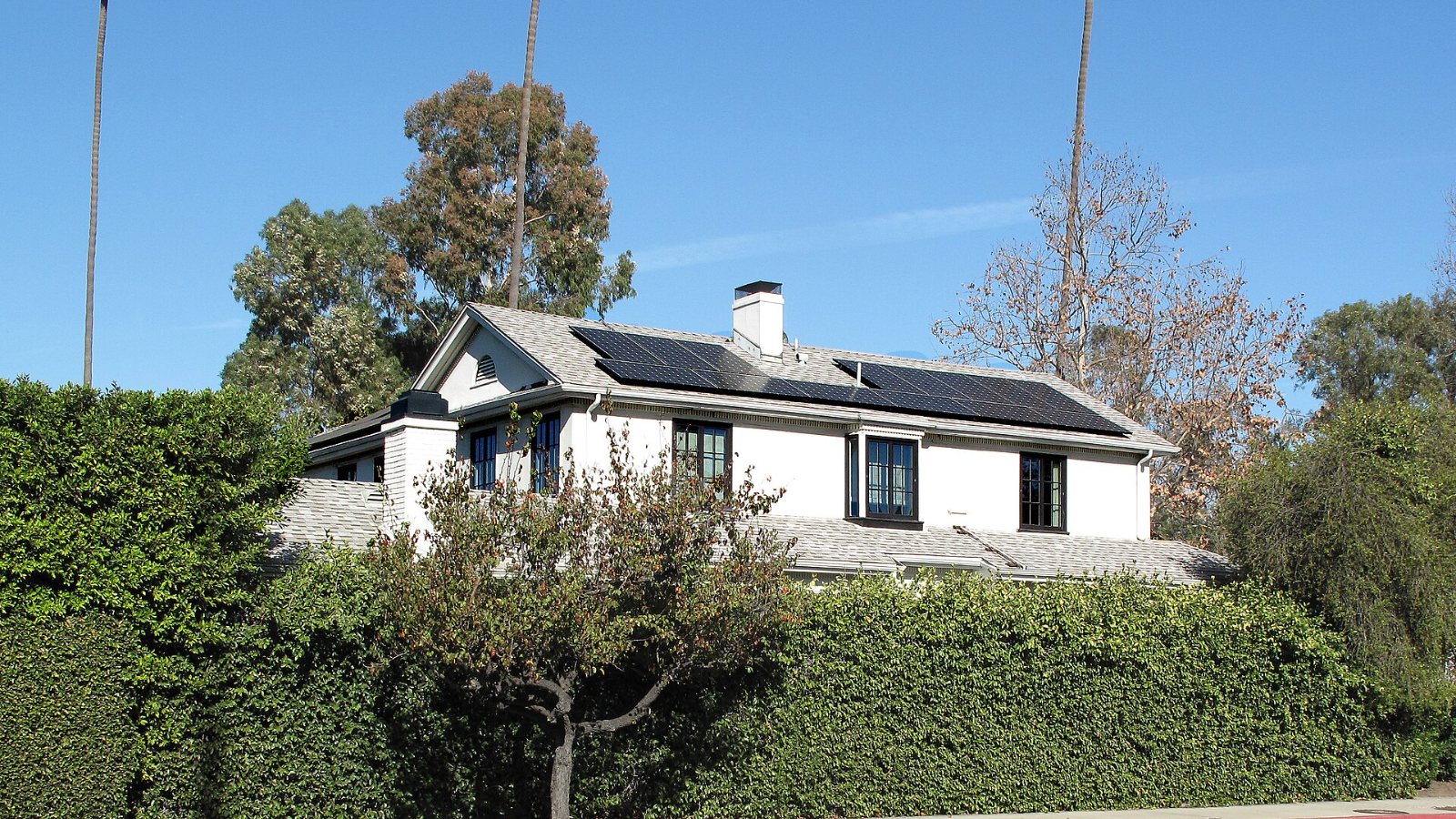
Cover photo: “Solar panel roof 6th St” by Downtowngal, CC BY-SA 4.0, cropped, via Wikimedia Commons.
Questions or a correction?
If something in this guide is unclear, out of date or does not match what your city told you, send me a message. Include the source if you have one.