The short answer: Seattle ADU fees include no ADU-specific permit fee: the Seattle Department of Construction and Inspections (SDCI) bases its fees on project valuation. The charge many owners miss is King County’s sewer capacity charge. An ADU counts as 0.59 of a residential customer equivalent, and at the 2026 rate of $77.99 per equivalent per month that is $46.01 a month for 15 years, about $8,282 if paid over the full term. Seattle Public Utilities (SPU) also publishes separate water, wastewater and drainage development charges, and whether they apply depends on your connections. This guide covers the fees the City, SPU and King County publish; for the cost of the build itself, see the permit data below.
Last verified: October 28, 2026 · Written by Marc
Attention: All figures below come from City of Seattle, SPU and King County pages. Those pages leave several questions open, and each needs a written answer from the agency: whether the County charge applies to a detached ADU tied into an existing side sewer, and whether SPU’s development charges apply to an ADU that shares the main house’s meter. We flag each one where it comes up.
Seattle ADU Fees From SDCI: Permit and Plan Review
Seattle’s 2026 Fee Subtitle, effective January 1, 2026, sets development fees from project valuation, expressed as percentages of a Development Fee Index, rather than as a flat amount. SDCI’s fee pages show no separate ADU fee. Four details help you budget:
- Estimator: SDCI publishes an Excel fee estimator, with a 2026 version, that you can fill in with your project’s valuation.
- Technology fee: the subtitle adds a charge of five percent of the fees required under the development chapters.
- Hourly rates: the subtitle lists an SDCI hourly rate of $292 for most work and a Land Use hourly rate of $551. Ask SDCI when hourly billing applies to your project.
- Payment timing: for building permits that need plan review, you owe 75% of the fees when SDCI accepts the application and the rest before it issues the permit.
We do not quote a dollar total for a Seattle ADU permit, because the City publishes a formula and an estimator rather than a fixed ADU amount.
King County Sewer Charge in Seattle ADU Fees
King County’s Wastewater Treatment Division bills a capacity charge to owners who connect to the sewer system. The County bills it monthly for 15 years, and you may pay the remaining balance in one lump sum at a discount at any time during that period. The SDCI form that collects the charge says all future billings can be prepaid at a discounted amount; call King County’s Wastewater Treatment Division at 206-477-5516 for your payoff figure.
| Item | Figure | Source |
|---|---|---|
| Rate for connections on or after January 1, 2026 | $77.99 per residential customer equivalent per month | King County |
| Detached or attached ADU | 0.59 residential customer equivalent | SDCI/King County form |
| Monthly charge for an ADU | 0.59 x $77.99 = $46.01 | Our calculation |
| Total over 15 years, undiscounted | $46.01 x 180 months = about $8,282 | Our calculation |
Per the SDCI form, the charge applies to all new sewer connections, reconnections or changes of use of existing connections. SDCI also reports every ADU permit to King County, and applicants sign an acknowledgment form. The form says the County may give credit for a demolition in some circumstances.
Key fact: You pay the charge over 15 years, which makes it easy to overlook in a first budget. Plan on paying it. The SDCI form that collects the charge has its own lines for attached and detached ADUs (0.59 RCE each), and the charge covers new connections, reconnections and changes of use of existing connections. Ask King County to confirm the amount for your permit.
SPU Development Charges in Seattle ADU Fees
SPU’s Director’s Rule FIN-220.2 (revision 5), effective January 1, 2026, sets these development charges:
| Charge | Published rate |
|---|---|
| Water | $6,900 per unit rate multiplied by a meter-size factor; a 3/4-inch meter is $6,900 |
| Wastewater | $2,600 for a 3/4-inch connection |
| Drainage | $1,225 per 1,000 sq ft of new hard surface |
What triggers them is the water service, not the ADU itself. Under SPU’s Director’s Rule FIN-219, the water and wastewater charges are measured by the size of a new water service or the increase in size of an existing one, and the drainage charge by the increase in hard surface. An ADU that shares the house’s existing service without upsizing it adds no new service to charge; a separate or larger meter does, and new roof and paving count toward drainage either way. Ask SPU’s development services office to confirm the figures for your plans.
Seattle ADU Fees: Are There Impact Fees?
The City’s Office of Planning and Community Development states that Seattle currently does not charge any impact fees. The page is undated and does not mention ADUs, so please confirm with the City. Where a Washington city does charge impact fees, state law (RCW 36.70A.681) provides that it may not assess impact fees on an ADU that are greater than 50% of the impact fees imposed on the principal unit, and the same statute bars owner-occupancy requirements. For more detail, our guide to Washington State ADU law covers the framework.
Pre-Approved Plans and Review Time
Seattle’s pre-approved ADU program goes by the name ADUniverse. The City’s 2026 submission guide says permits for one- and two-unit structures can issue in two to six weeks when the site has no environmentally critical area and no tree removal, with a reduced permit fee that reflects the shorter review. Licensing fees are capped at $1,500 per unit for residential-code plans, and the updated gallery is expected in November 2026, so check which designs are live when you apply. See ADU design cost: architect vs. pre-approved plans.
For total project costs rather than fees alone, see Seattle ADU cost.
For other projects, SDCI says it typically completes the initial plan review of simple and medium-complexity projects within two to four weeks after it accepts the application, and gives a target of eight to twelve weeks for complex projects. Those targets cover all projects, not only ADUs, and intake appointments are booked separately, so ask for the current wait when you book.
A Map of Seattle ADU Fees and the Cost to Build
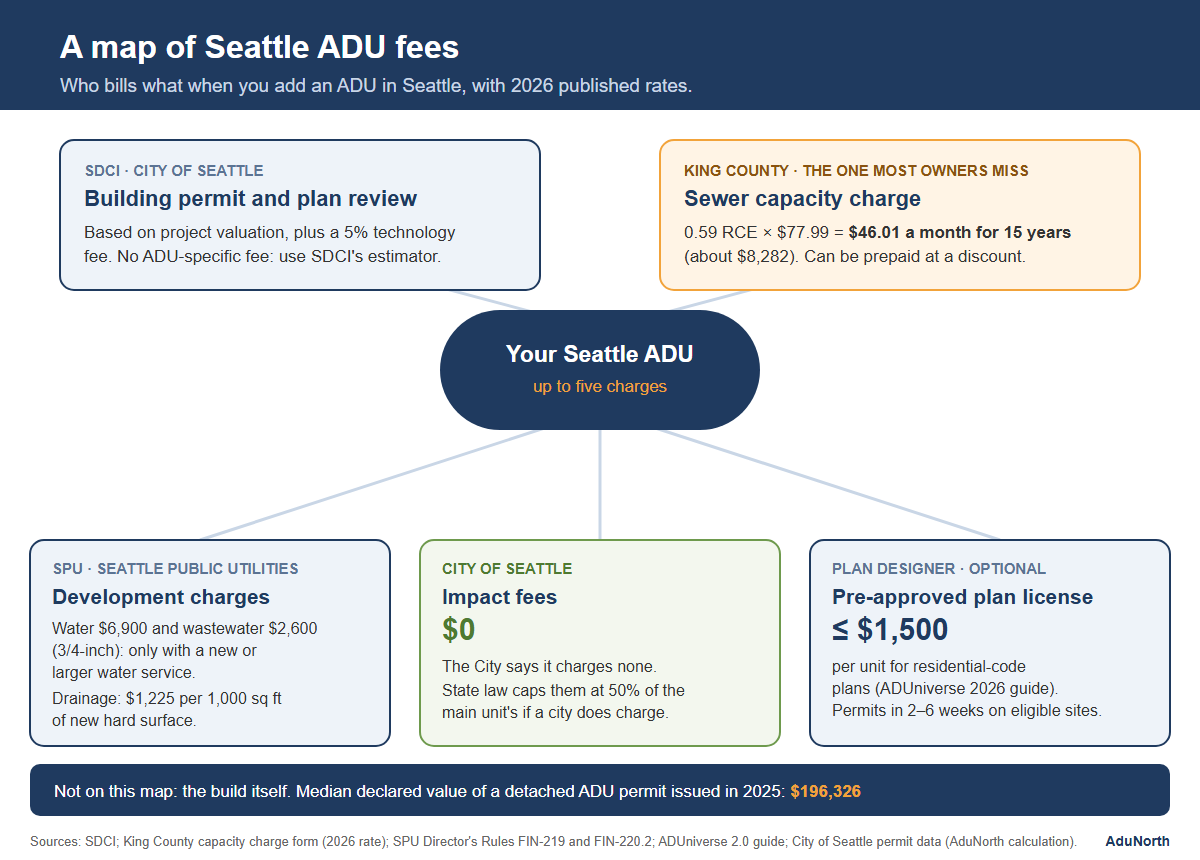
| Charge | Who bills it | Basis | What to confirm |
|---|---|---|---|
| Permit and plan review | SDCI | Project valuation, plus 5% technology fee | Estimator result; when hourly rates apply |
| Sewer capacity charge | King County | 0.59 customer equivalent x $77.99 per month for 15 years | Whether it applies to your connection; early-payment discount |
| Water, wastewater and drainage development charges | SPU | Meter size, connection and hard surface | Whether they apply to an ADU on an existing meter |
| Impact fees | City of Seattle | City says it charges none | Current status; state cap of 50% if charged |
| Design licensing fee (pre-approved plans) | Plan designer | Up to $1,500 per unit for residential-code plans (2026 guide) | Which catalog is live |
What Does It Cost to Build?
The City’s own permit records answer this. In Seattle’s building permit dataset, the median estimated project cost of a detached ADU permit issued in 2025 was $196,326 (our calculation from the City’s open data), before sales tax and the charges on this page. It is the value owners declared at permit, not a final price. To turn any estimate into a budget, see what an ADU costs in California and our ADU budget breakdown: get three written bids with line items and the same inclusions, and ask each bidder what the price leaves out.
How to estimate your Seattle ADU fees step by step
The charges on this page come from three agencies and a plan designer, so it is easy to miss one. Work through them in this order:
- Run SDCI’s 2026 fee estimator with your project valuation, then add the 5% technology fee.
- Plan the timing: 75% of the SDCI fees when the application is accepted for plan review, the rest before the permit is issued.
- Add the King County capacity charge: 0.59 × $77.99 = $46.01 a month for 15 years, or a discounted payoff from the Wastewater Treatment Division (206-477-5516).
- Ask SPU whether your plans need a new or larger water service. If they do, add the water and wastewater development charges: $6,900 and $2,600 for a 3/4-inch service.
- Measure the new hard surface (roof and paving) and add $1,225 per 1,000 sq ft for drainage.
- Add the plan license if you use a pre-approved design: up to $1,500 per unit for residential-code plans.
Here is a hypothetical example for a detached ADU with its own new 3/4-inch water service and 800 sq ft of new hard surface. SPU’s charges would be $6,900 + $2,600 + $980 = $10,480, before SDCI’s permit fees. The King County charge would add $46.01 a month, about $8,282 over 15 years if you do not prepay.
Practical tip: Ask SPU before you decide on a separate meter. Under FIN-219, an ADU that shares the house’s existing water service without upsizing it adds no new service to charge, while a separate or larger meter does.
Frequently Asked Questions
How are Seattle ADU fees for permits set?
SDCI sets permit fees from project valuation, as percentages of a Development Fee Index under the 2026 Fee Subtitle, with no ADU-specific amount. Use SDCI’s 2026 fee estimator with your valuation, then add the 5% technology fee. You pay 75% when SDCI accepts an application that needs plan review and the rest before it issues the permit.
What is the King County sewer charge for an ADU?
At the 2026 rate of $77.99 per residential customer equivalent per month, and 0.59 equivalent for an attached or detached ADU, it is $46.01 a month for 15 years, about $8,282 undiscounted. You can prepay the remaining balance at a discount at any time. King County’s Wastewater Treatment Division gives payoff figures at 206-477-5516.
Does Seattle charge ADU impact fees?
The City’s Office of Planning and Community Development says Seattle does not currently charge impact fees, although the page is undated and does not mention ADUs. Where a Washington city does charge them, RCW 36.70A.681 caps ADU impact fees at 50% of those on the principal unit. Confirm the current status with the City before you finalize your budget.
Is a pre-approved plan faster?
Usually. The City’s 2026 ADUniverse guide says permits for pre-approved one- and two-unit designs can issue in two to six weeks when the site has no environmentally critical area and no tree removal, with a reduced permit fee. For other projects, SDCI targets two to four weeks for the initial review of simple and medium-complexity projects, plus intake time.
The bottom line
Seattle ADU fees come from four places: SDCI’s permit fees based on valuation, King County’s sewer capacity charge of $46.01 a month for 15 years, SPU’s development charges when you add or enlarge a water service or hard surface, and a plan license if you use a pre-approved design. Seattle says it charges no impact fees.
Your next step is to work through the six steps above with your own valuation and site plan, then ask SDCI, SPU and King County to confirm the charges in writing. Compare the total with the costs in hidden ADU costs and utility hookups, and read the state rules in Washington State ADU law.
General information, not financial or legal advice. Fees and rates change; confirm with SDCI, SPU and King County.
Sources: SDCI: 2026 Fee Subtitle · SDCI: How much will your permit cost? · King County: Sewer capacity charge · SDCI: King County capacity charge form · SPU: Director’s Rule FIN-220.2 · Seattle OPCD: Impact fees · RCW 36.70A.681 · City of Seattle: ADUniverse gallery · SDCI: Review status and target due dates
Questions or a correction?
If something in this guide is unclear, out of date or does not match what your city told you, send me a message. Include the source if you have one.