The short answer: Compare ADU bids on scope before price. Ask every contractor to price the same plans with the same line items, then check what each one includes, excludes or covers with an allowance. In California, a home improvement contract over $500 must be in writing, the down payment cannot exceed $1,000 or 10% of the price, whichever is less, and progress payments must match work actually done. A bid that is far cheaper than the others usually leaves something out.
Last verified: October 29, 2026 · Written by Marc
This guide is based on California’s home improvement contract law, read on October 29, 2026. It is general information, not legal advice. Other states have different rules, and a lawyer can review a contract before you sign.
Three bids for the same ADU can differ by tens of thousands of dollars, and the lowest number is rarely the cheapest project. One bid includes the utility trench, another lists it as “by owner,” and a third hides it in an allowance. The only way to compare them is to make them say the same thing. This guide shows you how to request comparable bids, how to read them line by line, what California requires in the final contract and which warning signs to take seriously.
Step one: make the bids comparable
Before you compare numbers, give every bidder the same starting point:
- The same plans and specifications. Bids on different drawings cannot be compared.
- The soils report, if you have one. It decides the foundation, often the largest site line.
- A list of line items you want priced separately (see the table below).
- Your finish level, in writing: flooring, cabinets, fixtures and appliances, or a dollar allowance for each.
- A deadline and a format, so each bid arrives in the same structure.
Ask each contractor to state clearly what is excluded. “Exclusions” is where the differences between bids usually hide.
The line items to compare
Put the bids side by side in a spreadsheet with these rows. Mark each cell as priced, excluded or allowance:
| Line item | What to check |
|---|---|
| Design and engineering | Who pays the architect, structural engineer and Title 24 energy report |
| Permits and fees | Whether city permit, plan check, school and utility fees are included or passed through at cost |
| Site prep and demolition | Clearing, grading, haul-away and any demolition |
| Foundation | Type (slab or engineered) and whether it matches the soils report |
| Utility connections | Trenching, water, sewer, electrical service upgrade and gas |
| Framing, roof and exterior | Materials named, not just “per plans” |
| Windows and doors | Brand or performance level |
| Mechanical, electrical and plumbing | Heat pump, water heater, panel size |
| Kitchen and bath | Cabinets, counters, fixtures, appliances |
| Solar | Required for most new detached ADUs in California |
| Finishes | Flooring, paint, trim |
| Final cleanup and landscaping repair | Often excluded |
A June 2026 builder guide puts a standard slab foundation at $15,000 to $25,000 and an engineered one at $35,000 to $85,000. A single line like that can explain most of the gap between two bids, which is why matching the scope matters more than comparing totals.
Common mistake: choosing the lowest total without reading the exclusions. If one bid excludes utility connections or the electrical service upgrade, you will pay for them later, often through a change order at a higher price than in a competitive bid.
Allowances: the line most likely to grow
An allowance is a placeholder amount for something not yet chosen, such as tile or light fixtures. If you pick something more expensive, you pay the difference. Allowances are normal, but they make bids look cheaper when they are set unrealistically low.
To compare allowances fairly:
- Ask every bidder to use the same allowance amounts, or set them yourself.
- Check that each allowance covers both materials and installation.
- Ask how overages are billed and whether the contractor adds a markup.
Our guide to site prep and foundation costs shows why a site-work allowance with no list of inclusions is the riskiest of all.
What California requires in the contract
Once you choose a bidder, the contract itself must follow Business and Professions Code § 7159 if the price is over $500. The law requires, among other things:
- A written contract signed by both parties before work starts, with a copy for you.
- The contractor’s name, business address and license number. Check the license with the CSLB; our guide shows how to check a contractor’s license in California.
- A “Contract Price” in dollars and cents, and any finance charge listed separately.
- A description of the project and of the significant materials and equipment.
- Approximate start and completion dates, and what counts as substantial commencement.
- A down payment no greater than $1,000 or 10% of the contract price, whichever is less.
- A schedule of progress payments, each tied to specific work or materials.
- Change orders in writing, signed before the extra work starts, stating the scope, the cost and the effect on payments and schedule.
- Notices on commercial general liability insurance, workers’ compensation, mechanics liens and your right to require a performance and payment bond.
- A statement on subcontractors, and a list of them on request.
- A three-day right to cancel, or five days for a senior citizen, in most contracts not negotiated at the contractor’s place of business.
Down payments and progress payments
The payment rules protect you more than any other part of the contract. On a hypothetical $250,000 ADU contract, 10% would be $25,000, but the cap is the lesser amount, so the down payment cannot exceed $1,000.
After that, the law requires each progress payment to reference the work or materials it pays for. The contract must state, in bold type, that it is against the law for a contractor to collect payment for work not yet completed or materials not yet delivered. A schedule that asks for large sums before the matching work is done is a reason to stop and ask questions.
A simple way to read a payment schedule:
- List each payment and the work it is tied to.
- Check that the work is specific: “foundation poured and inspected,” not “phase 2.”
- Make sure no payment runs ahead of the work it pays for.
- Plan to pay only after the matching inspection passes.
Practical tip: Tie each progress payment to a city inspection where possible: foundation, framing, rough mechanical and final. An inspection is an outside confirmation that the work you are paying for is done.
Protecting yourself from liens
California contracts must include a mechanics lien warning. It explains that subcontractors and suppliers who are not paid can record a lien on your property even if you paid the main contractor. Each one must send you a “Preliminary Notice” to keep that right, and the notice can arrive up to 20 days after they start work or deliver material.
The warning suggests ways to protect yourself: get a list of all subcontractors and suppliers, track the Preliminary Notices you receive and consider paying with joint checks made out to the contractor and the subcontractor or supplier. The contract must also state that, after each payment, the contractor will provide an unconditional lien release for the work paid for. Ask for those releases every time.
Red flags in a bid
Most problems show up before the contract is signed:
- A bid far below the others with a long list of exclusions
- A down payment request above $1,000 or 10% of the price
- Payment milestones not tied to specific work
- No license number, or a license that does not match the name on the bid
- Pressure to sign the same day or to skip the permit
- Vague materials (“standard,” “builder grade”) with no brand or specification
- No mention of insurance, or a refusal to show proof of it
Any one of these deserves a question. Several together are a reason to walk away.
Frequently asked questions
How many bids should I get for an ADU?
Three is a common number: enough to see a range without making the process unmanageable. What matters more than the count is that every bidder prices the same plans, line items and allowances. Three comparable bids tell you more than five bids built on different assumptions.
How much can a contractor ask as a down payment in California?
For a home improvement contract over $500, the down payment may not exceed $1,000 or 10% of the contract price, whichever is less. On most ADU contracts that means $1,000. The rule comes from Business and Professions Code section 7159, and the contract must state it in bold type.
Is the lowest ADU bid a bad sign?
Not always, but check it carefully. A low bid often excludes items others include, uses low allowances or assumes a cheaper foundation than the soils report supports. Compare it line by line. If the scope truly matches, a lower price can be legitimate; if it does not, the savings may return as change orders.
What should a change order include?
In California, a change order must be in writing and signed before the extra work begins. It must describe the scope of the extra work or change, the amount added to or subtracted from the contract, and the effect on the progress payments or the completion date. Keep every signed change order with your contract.
Can I cancel an ADU contract after signing?
Often, within a short window. Most California home improvement contracts must include a three-day right to cancel, or five days for a senior citizen, unless the contract was negotiated at the contractor’s place of business. You cancel in writing, and the contractor must return payments within 10 days of receiving your notice.
The bottom line
To compare ADU contractor bids, make them comparable first: same plans, same line items, same allowances and a clear list of exclusions. Then read the contract against California’s rules: over $500 it must be written, the down payment is capped at $1,000 or 10%, whichever is less, and every progress payment must match completed work. The lowest total is only a good deal when the scope matches.
Your next step is to send all bidders the same plans and line-item list, then lay the answers out in one spreadsheet. Before you sign, check the contractor’s license and plan the payments with your ADU construction loan draw schedule.
Sources
- Cal. Bus. & Prof. Code § 7159 (home improvement contracts)
- CSLB: Check a License
- ADU Scale: California ADU cost guide (builder, updated June 2026)
General information, not legal or financial advice. Rules and prices change; confirm with the agency or professional involved.
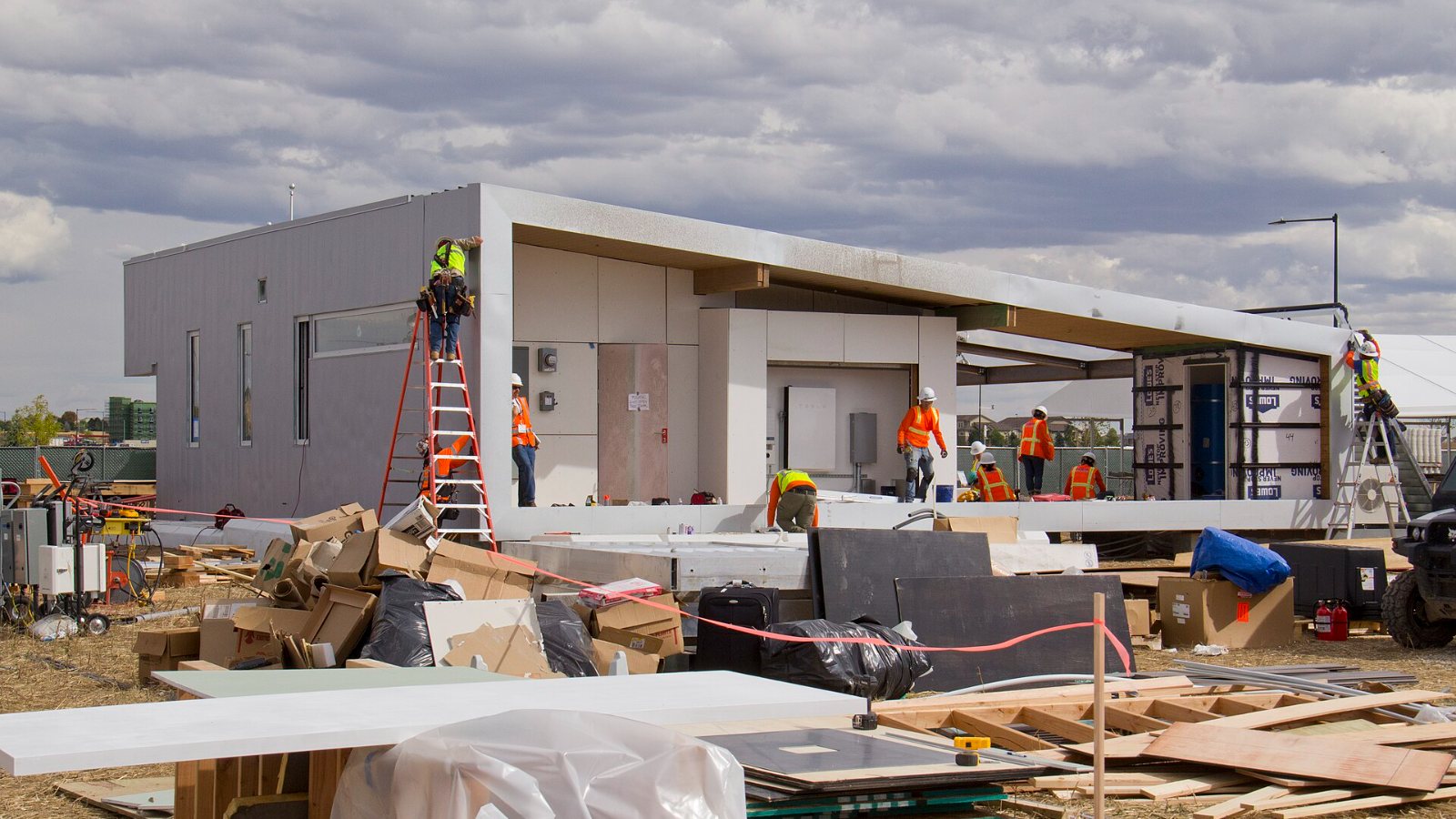
Cover photo: “MG 4408 (37477051801)” by U.S. Department of Energy Solar Decathlon, public domain, via Wikimedia Commons.
Questions or a correction?
If something in this guide is unclear, out of date or does not match what your city told you, send me a message. Include the source if you have one.