
The short answer: The ADU permit timeline is set by law: a California city has 15 business days to tell you whether your ADU application is complete and 60 days to approve or deny it once it is. In practice, the only published dataset we found, covering 2018 to 2022, shows average waits of about 100 to 260 days, depending on the county and whether the lot sits in the coastal zone. The gap between the legal clock and the real one is where most homeowners lose months.
Not sure your lot qualifies yet? Start with our 5-step check: can I build an ADU on my property?
Last verified: October 28, 2026 · Written by Marc
Key fact: the 60-day clock starts only when your application is complete. A city that sends an incomplete notice, and an applicant who needs time to fix it, can stretch a “60-day” permit into many months without anyone breaking the law.
The ADU permit timeline: what state law promises
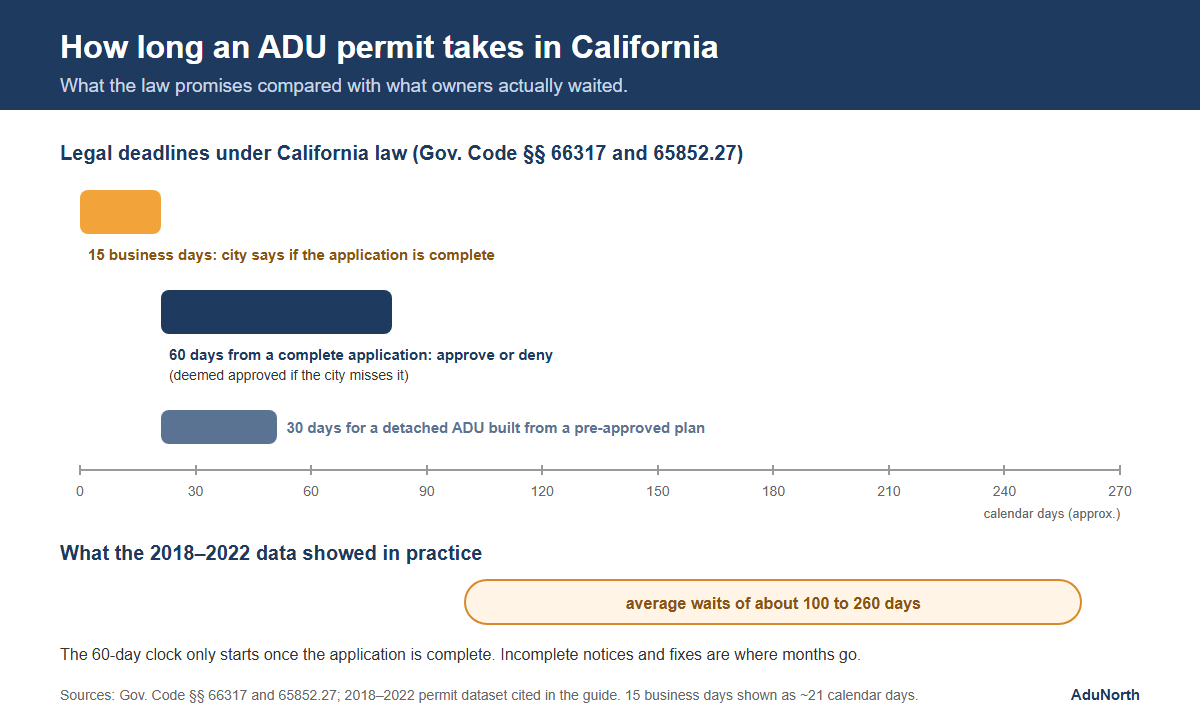
California’s ADU rules put two deadlines on every city. The state housing agency’s handbook (March 2026) cites Government Code § 66317 for both.
- 15 business days: the city must decide whether your application is complete and send written notice. If the notice is “incomplete,” it must list what is missing and how to fix it.
- 60 days: after a complete application, the city must approve or deny it. Review is ministerial, meaning staff check the plan against the code and have no discretion to reject a compliant design.
If the city misses the 15-business-day deadline, the application is deemed complete. If you disagree with an incomplete notice or a denial, you can appeal, and the city owes you a final written decision within 60 business days of the appeal. If you ask the city for more time, the 60-day period pauses for the length of the delay.
Some cities also write a “deemed approved” rule into their own ordinance. Los Angeles’s ordinance, for example, says an application is deemed approved if the city has not acted within 60 days. Check whether your city’s ordinance says the same.
What the data shows on the ADU permit timeline
The best public data comes from the Terner Center at UC Berkeley, which analyzed the annual progress reports cities file with the state housing department. It measured the average days from application to permit approval for 2018 to 2022.
| County | Inside the coastal zone | Outside the coastal zone |
|---|---|---|
| Los Angeles County | 260 days | 147 days |
| Orange County | 233 days | 101 days |
| San Diego County | No statistically significant difference between zones |
Attention: these numbers are averages from 2018 to 2022, before several recent state laws. The researchers could identify both an application date and a permit date for only about 29,000 of roughly 60,000 ADU projects, and they warn the usable records may be biased. Treat them as a rough historical benchmark, not a prediction for your city: they are averages, they predate recent state laws, and some projects may be missing from the data.
For your own city, ask the planning counter for its current average review time and compare it with the 60-day legal limit. Be wary of guides that quote precise numbers for a specific city without naming a data source.
Why the real ADU permit timeline runs longer than the law
The 60-day rule covers only one stage. Several things sit outside it.
The completeness loop
The clock for approval does not start until the city says your application is complete. Each incomplete notice sends you back to your designer, and resubmitting restarts the review. A missing structural detail or a forgotten form can cost weeks, even though the city is within its 15-business-day window every time.
Time you ask for
If you request a delay, the 60-day period is paused for that delay. That is fair, but it means your own revisions count against the calendar and not against the city.
Other approvals that run separately
Some cities run planning review separately from the building permit. Sacramento does not require it up front: its ADU guide says no separate planning or zoning approval is needed before you submit a building permit application, though an optional zoning review is available. Utility approvals, school fee payments and special reviews sit on top of that.
Coastal and special areas
Coastal lots add a coastal development permit. Under AB 462, effective October 10, 2025, the city or the Coastal Commission must approve or deny that permit within 60 days of a complete application. The handbook adds that an application is deemed approved if the Coastal Commission does not act within that window on a lot with an existing primary dwelling. The Terner data shows why this matters: in Los Angeles and Orange counties, coastal-zone applications averaged more than 100 days longer.
A sample timeline: how 60 days becomes four months
The legal deadlines are easier to plan around when you see them on a calendar. The example below is hypothetical and assumes one incomplete notice, which is common for first submittals.
| Stage | Who has the clock | Example length |
|---|---|---|
| City checks completeness | City, up to 15 business days | 3 weeks |
| You fix the items listed in the notice | You | 3 weeks |
| City checks the resubmittal | City, up to 15 business days | 2 weeks |
| City approves or denies the complete application | City, up to 60 days | 8 weeks |
| Total | About 16 weeks |
Every stage stayed within the law, and the permit still took about four months. The weeks you control are the ones where you fix the notice. A complete first submittal removes two of the four rows.
How to shorten your ADU permit timeline
- Ask for a pre-application meeting. Confirm setbacks, unit type and overlays in writing before you pay for plans.
- Use the city’s pre-approved plans if they fit. San Diego, for instance, gives pre-approved plans a 30-day review period.
- Submit a complete package. Use the city’s checklist and ask staff to confirm it before filing.
- Answer incomplete notices in one round. Collect every item the city lists and resubmit once.
- Keep a log. Note the date the city received your application, the date of each notice and every request for delay. You will need it if you appeal.
Practical tip: email your planner after filing and ask them to confirm the date your application is considered complete. That date starts the 60-day clock.
What to do if the city misses a deadline
- Check your records: when was the application filed, and has the city sent a written completeness notice?
- If 15 business days have passed without written notice, the application is deemed complete. Say so in writing and cite Government Code § 66317.
- If the 60 days have passed, ask in writing for the decision and quote your city’s ordinance if it has a deemed-approved rule.
- Use the city’s appeal process, then contact the state housing department’s ADU resources. HCD offers technical assistance on state ADU law and can review local ordinances for compliance.
FAQ
Does the 60 days include construction?
No. The 60 days cover only the city’s decision on a complete permit application. Design comes before it, and construction and inspections come after it. Utility approvals, school fee payments and coastal permits can also run on separate calendars. When you plan a move-in date, count each stage separately rather than treating the permit deadline as the whole project.
Can the city deny my ADU after 60 days?
If the application complies with the code, review is ministerial, so the city has no discretion to reject it. A denial must list every defect and explain how to fix it. You can appeal, and the city owes a final written decision within 60 business days of the appeal. Some ordinances, such as Los Angeles’s, also treat an application as approved if the city does not act within 60 days.
If your application is denied, what to do after an ADU permit denial covers the correction and appeal steps.
Do these timelines apply outside California?
No. The 15-business-day and 60-day deadlines come from California’s Government Code, and other states set their own rules, or none. Some leave review times entirely to local codes. Our guide to ADU laws by state explains what each state covers, and your planning department can tell you its current average review time.
Do garage conversions go faster?
The legal deadlines are the same, but conversions are often simpler to review because the structure, its foundation and its position on the lot already exist. In California, a conversion inside existing space also needs no new setback. Expect the review to focus on fire safety, exterior access, structure and energy upgrades rather than on where the building sits.
The bottom line
California gives cities 15 business days to decide whether an ADU application is complete and 60 days to approve or deny it once it is. Historical data from 2018 to 2022 shows average waits of about 100 to 260 days, mostly because of incomplete submittals and separate approvals that sit outside the legal clock.
Your next step is to cut the rounds you control. Ask for a pre-application meeting, use the city’s checklist or a pre-approved plan, and keep a dated log from the day you file. Then compare what you will pay with our ADU permit cost by city guide, and check the local process in Los Angeles, San Diego or San Jose.
General information, not legal advice. Local rules vary and change; confirm with your planning department.
Sources: HCD ADU Handbook, March 2026 (PDF) · Terner Center, Comparing ADU Permitting Time Inside and Outside the Coastal Zone · Los Angeles City Planning, ADU Ordinance · City of San Diego, Information Bulletin 400 · City of Sacramento, ADU Application Submittal
Questions or a correction?
If something in this guide is unclear, out of date or does not match what your city told you, send me a message. Include the source if you have one.