The short answer: San Jose ADU requirements allow ADUs on single-family lots, with detached units of up to 1,000 sq ft on lots up to 9,000 sq ft and 1,200 sq ft on larger lots, and Junior ADUs (JADUs) of up to 500 sq ft. Single-story detached units can be 18 feet tall, and standard detached ADUs need 4-ft side and rear setbacks.
Last verified: October 28, 2026 · Written by Marc
Read this first: the detailed numbers below come from San Jose Ordinance 30516, adopted January 26, 2021. State law has changed since then, and in December 2025 the state housing department (HCD) told San Jose that its 2021 ordinance may be out of compliance with current state ADU law and asked it to clarify or amend it. The city’s “ADU Ordinance & Updates Archive” lists changes only through 2020. The city also says it enacts state ADU legislation in its zoning code and that its ADU Universal Checklist (Bulletin 210) reflects state law, so read the checklist first and confirm the current numbers with the city before you design.
San Jose ADU requirements: unit types and size limits
The city’s ADU page lists three types: ADUs, JADUs (under 500 sq ft inside the footprint of a single-family home), and tiny homes on wheels (THOWs), which are allowed only on single-family properties with a simpler, lower-cost permit process.
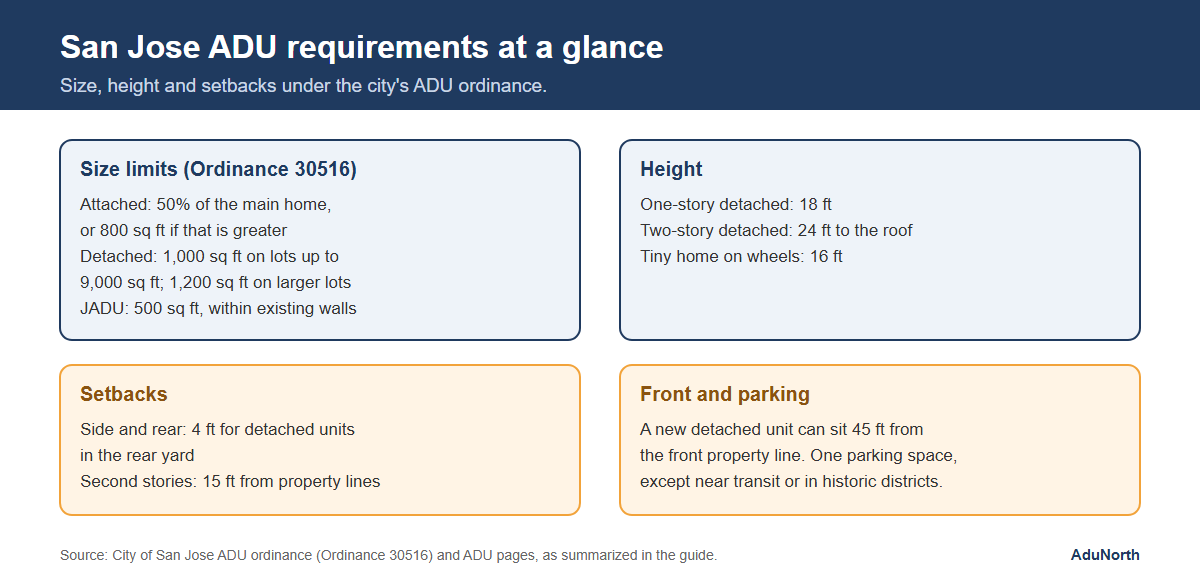
San Jose ADU requirements: size limits (Ordinance 30516)
| Type | Limit |
|---|---|
| Attached ADU | 50% of the main home, or 800 sq ft if that is greater |
| Detached ADU | 1,000 sq ft on lots up to 9,000 sq ft; 1,200 sq ft on larger lots |
| JADU | 500 sq ft, within existing walls |
San Jose ADU requirements: height, setbacks and parking
- Height: 18 ft for a single-story detached ADU; 24 ft to the roof for a two-story detached ADU; 16 ft for a tiny home on wheels.
- Side and rear setbacks: 4 ft for detached units in the rear yard.
- Front: a new detached unit can sit 45 ft from the front property line.
- Second stories: second-story units need 15-ft setbacks from property lines.
San Jose ADU requirements for parking
The ordinance requires one on-site space, except within half a mile of transit, or in historic districts, as listed in the ordinance. Ask the city whether tandem parking and garage-replacement rules apply to your project.
San Jose ADU requirements on owner occupancy
Standard ADUs generally do not require owner occupancy. The 2021 ordinance requires it for JADUs, with exceptions for nonprofits and land trusts. State law has since narrowed this: under AB 1154, a JADU requires the owner to live on the property only if it shares a bathroom with the main house. Ask the city which rule it applies today.
Legalizing an unpermitted ADU
San Jose runs an “AB 2533, ADU and JADU Legalization Program” for units built or converted without a permit before January 1, 2020. You need proof of that date. The city accepts assessor and agency records, escrow papers or transfer disclosures, dated photos or aerial imagery, insurance policies, past leases, contractor invoices and dated materials or equipment. Without proof, the unit has to be permitted as a new ADU.
The city’s steps are: read the FAQ and the Substandard Housing Checklist (Bulletin 214); gather proof of the date; optionally book a confidential third-party pre-inspection; prepare as-built plans; email the ADU Ally team at adu.ally@sanjoseca.gov with proof of date, Bulletin 214, as-built plans, Form 310 and Form 312; then go through plan review, permit and inspection. The inspection is described as a safety-focused review, not a full building-code compliance check.
According to the city’s FAQ, setbacks, lot size, height and parking cannot block legalization, an open code enforcement case is closed after final inspection, and the fee for work without a permit is not charged. Normal permit, plan-check and inspection fees still apply, and the city says impact, capacity and connection fees do not, except in specific circumstances. The city quotes 4 to 6 months from a complete application. San Jose also had an earlier amnesty program that ended in January 2022; do not rely on its old fee figures. For the statewide rules, see our guide to legalizing an unpermitted ADU.
San Jose’s permit process, fees and review times
San Jose does not use separate planning and building applications for ADUs; it uses one online flow. The city’s process page lists these steps:
- Complete the ADU Universal Checklist (Bulletin 210). You can ask a planner for feedback by phone at 408-535-3555 or at ZoningQuestions@sanjoseca.gov.
- Prepare plans following Bulletin 211, and read the ADU Inspection Checklist (Bulletin 213), Building Division Note 34 for JADUs and the fire requirements.
- Use the Application Wizard and create an SJPermits.org account, naming an ePlan applicant.
- Upload the package to SJePlans: plans, inspection checklist, Title 24 energy calculations and CalGreen checklist, a geotechnical report where applicable, a water company hydrant flow letter, Form 302 (address assignment) and Form 312 (ADU owner declaration). A JADU uses Form 313, a deed restriction that needs a wet signature.
- Pass prescreen and plan review. To get the permit you pay the remaining plan review and inspection fees, the permit application fee, and school and parkland fees where they apply.
- Request inspections, and complete the Construction & Demolition Diversion sign-off before final inspection.
The city warns that projects are often delayed without the hydrant flow letter. Multifamily lots, tiny homes on wheels and AB 2533 cases go to the city’s ADU Ally team (adu.ally@sanjoseca.gov, 408-793-5302).
Practical tip: Ask your water company for the hydrant flow letter as soon as design starts. It has to show at least 1,000 gpm at 20 psi from the nearest hydrant, and a missing letter is the delay the city warns about most.
San Jose ADU requirements: fees and review times
- School and parkland fees: the city says school impact fees do not apply to ADUs under 750 sq ft, and parkland fees, which vary by location, also do not apply under 750 sq ft. Above that size, contact the school district.
- Building permit fees: they depend on ADU size. The city points to its Building Fee Schedule and a Building Fee Estimator and publishes no total for an ADU.
- Other possible charges: geological hazard review and clearance, a tree removal permit and fire variance fees.
- Planner pre-meeting: when we read the page, a virtual preliminary meeting was billed at $398 per hour with a 30-minute minimum.
The city says the first round of building review typically takes 20 business days unless your plans need additional review. State law separately limits the city to 60 days to decide once your application is complete. Property tax will increase based on the value of the ADU. For a statewide comparison see how long an ADU permit takes in California.
Fire access, water and utilities
San Jose’s fire rules are where many projects get stuck. According to the city’s ADU FAQ:
- If the primary home has fire sprinklers, the ADU must have them. An attached ADU over 500 sq ft where the combined floor area exceeds 3,600 sq ft requires sprinklers throughout the house and ADU.
- Every part of the ADU must be within 150 feet of the curb along a clear path at least 4 feet wide, or you may need a fire variance.
- A hydrant must be within 600 feet of all exterior walls, or you may need a variance, and the nearest hydrant must deliver at least 1,000 gpm at 20 psi. A letter from your water company proves this.
- The house and the ADU each need their own address, with numbers visible and legible from the street.
On utilities, the city says PG&E is now requiring ADUs to have their own meter, that the city does not dictate PG&E’s metering policies, and that a JADU needs no separate meter. Confirm with PG&E before you design the electrical service. The city also says it has paused enforcement of its natural gas prohibition ordinance. See our guide to utility meters for ADUs for the statewide picture. For sewer lateral questions on your lot, contact the city’s ADU Ally (adu.ally@sanjoseca.gov, 408-793-5302).
Pre-approved ADUs, renting and selling
The city describes its pre-approved ADU program as the fastest and lowest-cost permit process, and says same-day permit issuance is available if the site-specific documents are complete. To be eligible your lot must be residential-zoned with an existing single-family home or duplex, and must not be in a geohazard, landslide, flood or wildland-urban interface zone. Approved plans range from about 476 to 991 sq ft, and the list of vendors changes, so use the city’s page for the current list.
Renting and selling
The city says an ADU can be built where the main house is a rental, and the house and the ADU can be rented to different parties. Fair housing law applies and you cannot refuse housing vouchers. The minimum rental term for an ADU is 30 days, including for Airbnb-style rentals, under state law. Selling an ADU separately requires a condominium conversion; see can you sell an ADU separately.
FAQ
Can I build two ADUs?
State law lets a typical single-family lot combine a converted ADU, a JADU and an 800 sq ft detached ADU, and cities must allow those together. San Jose’s 2021 ordinance predates several of those changes, and HCD told the city in December 2025 that it may be out of compliance. Ask the city how it applies the combination on your lot, and cite its ADU Universal Checklist.
Do I need to live there?
Not for a standard ADU. The 2021 ordinance requires owner occupancy for JADUs, with exceptions for nonprofits and land trusts, but state law has narrowed that: under AB 1154, a JADU requires the owner to live on the property only if it shares a bathroom with the main house. Ask the city which rule it applies today. The house and the ADU can be rented to different parties.
Is an ADU the same as a tiny home on wheels?
No. San Jose treats a tiny home on wheels as its own unit type, allowed only on single-family properties, with a simpler, lower-cost permit process and a 16-foot height limit. A standard single-story detached ADU can be 18 feet tall and needs 4-foot side and rear setbacks. Tiny homes on wheels go through the city’s ADU Ally team.
How long does a San Jose ADU permit take?
The city says the first round of building review typically takes 20 business days unless your plans need more review, and pre-approved ADUs can get a same-day permit if the site documents are complete. State law gives the city 15 business days to check completeness and 60 days to decide. Legalizing an unpermitted ADU takes 4 to 6 months from a complete application, according to the city.
The bottom line
San Jose ADU requirements, based on the 2021 ordinance, allow detached ADUs of up to 1,000 sq ft on lots up to 9,000 sq ft and 1,200 sq ft on larger lots, JADUs of up to 500 sq ft, 18-foot single-story units and 4-foot side and rear setbacks. Fire access and the hydrant flow letter are where many projects stall, and state law has changed some local rules since 2021.
Your next step is to complete the ADU Universal Checklist (Bulletin 210) and ask a planner to confirm the current numbers. Compare fees in ADU permit cost by city, and if the unit already exists without a permit, read how to legalize it under AB 2533.
General information, not legal advice. Local rules vary and change; confirm with your planning department.
Sources: San Jose Ordinance No. 30516 (2021) · City of San Jose, Accessory Dwelling Units · HCD ADU Handbook · City of San Jose, ADU plan review and permit process · City of San Jose, ADU FAQs · City of San Jose, Preapproved ADUs · HCD, San Jose ADU ordinance review letter (December 10, 2025)
Questions or a correction?
If something in this guide is unclear, out of date or does not match what your city told you, send me a message. Include the source if you have one.