
The short answer: Arizona ADU law (HB 2720), signed in May 2024 and codified at A.R.S. section 9-461.18, requires municipalities with more than 75,000 residents to allow at least one attached and one detached ADU on single-family lots. ADUs can be limited to 75% of the main house’s floor area or 1,000 sq ft, whichever is smaller. Cities cannot require extra parking, cannot require a family or employment relationship between the owner and the occupant, and cannot impose side or rear setbacks above 5 feet. Cities had until January 1, 2025 to adopt compliant regulations.
Last verified: October 28, 2026 · Written by Marc
Key fact: According to an Arizona State University brief, HB 2720 affects 16 municipalities (Phoenix, Tucson, Mesa, Chandler, Gilbert, Glendale, Scottsdale, Peoria, Tempe, Surprise, Goodyear, Buckeye, Yuma, Avondale, Flagstaff and Queen Creek). The statute does not list the covered cities, so this list is an estimate: Flagstaff exceeds 75,000 on census data, while Queen Creek (59,308 in the 2020 census) qualifies only on recent population estimates. If your town has fewer than 75,000 residents, the state mandate does not apply and local zoning decides.
Who the Arizona ADU Law Applies To
HB 2720 covers municipalities with a population above 75,000. The bill excludes tribal lands and areas affected by military airports and FAA-licensed or general aviation airports, which means some parcels near airports may not benefit from the mandate even inside a covered city.
The ASU Morrison Institute brief reports that before the law, most Arizona cities allowed only one ADU per parcel, only two permitted ADUs in all residential zones, at least four required off-street parking, and many applied height limits stricter than those for main houses. The law was designed to standardize those rules across large cities.
What happens if a city did not update
The bill text provides that municipalities had to adopt development regulations by January 1, 2025. If they did not, ADUs become allowed on all residential parcels without restrictions, according to the legislative summary. In practice, you should check the current city code and, if it appears outdated, ask the planning department which state provisions it applies.
Practical tip: Ask your planning department whether the city’s ADU code was updated for HB 2720, and request the section number. If the answer is unclear, put the question in writing.
How Many ADUs and How Large Under Arizona ADU Law
On a lot zoned for single-family homes, covered cities must allow a minimum of one attached ADU and one detached ADU as permitted uses. A third detached ADU is allowed on parcels of one acre or more if at least one of the units is restricted as affordable.
| Topic | HB 2720 rule |
|---|---|
| Number of ADUs | At least one attached and one detached |
| Extra detached ADU | On parcels of one acre or more, if at least one unit is restricted-affordable |
| Maximum size | 75% of the main house’s gross floor area or 1,000 sq ft, whichever is smaller |
| Height | Must match regulations for primary structures |
| Side and rear setbacks | Cannot exceed 5 feet |
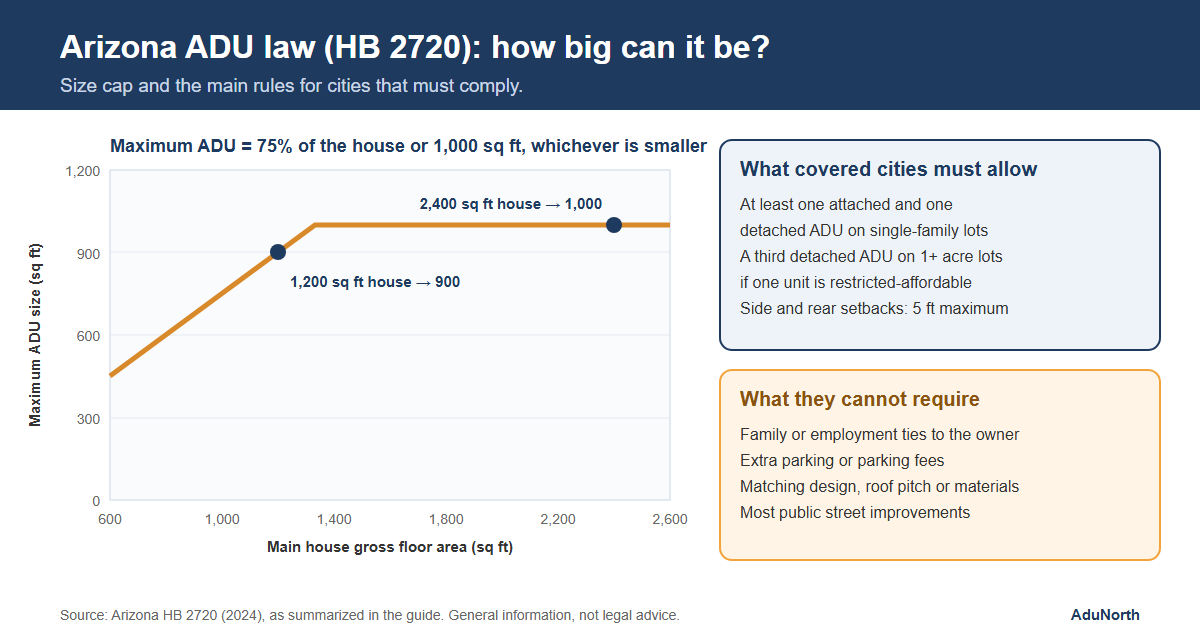
The 75% or 1,000 sq ft rule works the same as Portland’s approach to size: a small house limits a new ADU. A 1,200 sq ft house, for example, allows an ADU up to 900 sq ft (75% of 1,200), while a 2,400 sq ft house allows up to 1,000 sq ft.
Why the setback rule matters
Cities cannot require more restrictive height, setbacks, lot size, coverage or building frontage than apply to single-family homes, and they cannot require rear or side setbacks above five feet. That second rule is the practical one for backyard units: on a typical lot, a five-foot limit leaves much more usable space than a 10- or 15-foot setback.
What Cities Cannot Require Under Arizona ADU Law
The bill lists several prohibitions that remove common barriers.
- Family, marital or employment relationships between the owner and occupant.
- Additional parking or parking fees.
- Matching exterior design, roof pitch or finishing materials to the main house.
- Public street improvements unless directly affected by the project.
- Restrictive covenants on residential-zoned parcels, as stated in the legislative summary.
- Separate advertising restrictions from those on the main dwelling.
The ASU brief also states that cities must allow the main house and the ADU to be rented long term. Before the law, some cities limited who could live in an ADU, for example only relatives. That is no longer allowed in covered cities.
Attention: The “restrictive covenants” item in the legislative summary does not clearly say HOA rules are void. It is not clear how courts or associations apply it, so treat HOA documents as potentially binding until an attorney tells you otherwise (see our article on HOAs).
Owner Occupancy and Short-Term Rentals
For ordinary long-term use, Arizona cities cannot require owner occupancy or any relationship between owner and tenant. Short-term rentals are different. The legislative summary says vacation or short-term rental operators must live on site if the ADU was built after the effective date and functions as a vacation rental. The ASU brief adds that other state statutes allow cities to impose short-term rental limits, including owner-occupancy requirements for ADUs with a certificate of occupancy or final approval on or after September 14, 2024 (A.R.S. section 9-500.39).
Put simply: you can generally rent an ADU long term without living there, but if you plan to use it as an Airbnb, you may need to live on the property, depending on when it was built and your city’s rules.
| Use | Owner-occupancy rule |
|---|---|
| Long-term rental | Cannot be required |
| Family or personal use | Cannot be required |
| Short-term rental in a post-effective-date ADU | Operator may need to live on site |
A worked example: one lot in a covered city
The rules are easier to apply on a real shape. Take a hypothetical lot in a city of more than 75,000 residents, 60 feet wide, with a 1,600 sq ft house.
| Rule | How it applies to this lot | Result |
|---|---|---|
| Size cap | 75% of 1,600 sq ft is 1,200 sq ft, above the 1,000 sq ft limit | ADU up to 1,000 sq ft |
| Number of units | One attached and one detached must be allowed | Up to two ADUs |
| Side setbacks | No more than 5 feet each side | At least 50 feet of the 60-foot width stays buildable |
| Parking | No additional parking can be required | No new space needed |
| Long-term rental | No owner-occupancy or relationship rule | Main house and ADU can both be rented long term |
Now change one input. With a 1,000 sq ft house, 75% is 750 sq ft, so the ADU cap drops to 750 sq ft even on the same lot. The size of the house, not the lot, is what limits the unit most often.
The width line shows why the setback rule matters. If a city could still demand 10 feet on each side, the same lot would keep only 40 feet of buildable width, which is 10 feet less for the ADU.
Common mistake: assuming the state rules apply because your address says Phoenix or Tucson. Check the parcel itself for airport-area or tribal-land exclusions, which can remove it from the mandate even inside a covered city.
Practical Steps Under Arizona ADU Law
- Confirm your city has more than 75,000 residents.
- Check your parcel for airport or tribal-land exclusions.
- Read your city’s current ADU section and compare it with the table above.
- Check HOA or deed restrictions.
- Get a written fee estimate, since neither HB 2720 nor its summaries mention caps on permit or plan-check fees.
- Decide early whether the unit will be a long-term rental, family housing or a short-term rental.
Fees deserve a note. HB 2720 itself does not set fee caps, but a separate 2026 law (HB 2946, which added subsection U to A.R.S. section 9-463.05; confirm its effective date) limits development fees on ADUs: water and wastewater fees may not exceed the incremental increase in demand, and other fees may not exceed the lesser of 25% of the total development fees or the proportionate share for a single-family home. ADUs are not fee-free, so ask the city for a written estimate.
Frequently Asked Questions
Does HB 2720 apply to every Arizona city?
No. It applies only to municipalities with more than 75,000 residents, which an Arizona State University brief counts as 16, including Phoenix, Tucson, Mesa and Chandler. The statute does not list the cities, so check your city’s current population. Tribal lands and areas affected by certain airports are excluded, and in smaller towns local zoning still decides.
How many ADUs can I build?
On a lot zoned for single-family homes in a covered city, the city must allow at least one attached and one detached ADU as permitted uses. A third, detached ADU is allowed on parcels of one acre or more if at least one of the units is restricted as affordable. Your city may allow more, but it cannot allow fewer.
Can the city require extra parking?
No. Under HB 2720, a covered city cannot require additional off-street parking for an ADU or charge parking fees in its place. That removes a barrier that, according to the ASU brief, at least four Arizona cities used before the law.
Do I have to live on the property?
Not for long-term use. Covered cities cannot require owner occupancy or a family or employment relationship between the owner and the occupant. Short-term rentals are different: the legislative summary says operators of vacation rentals in ADUs built after the effective date must live on site, and A.R.S. 9-500.39 lets cities impose owner-occupancy rules on newer short-term rental ADUs.
How big can the ADU be?
Up to 75% of the main house’s gross floor area or 1,000 sq ft, whichever is smaller. A 1,200 sq ft house allows an ADU of up to 900 sq ft, while any house of 1,334 sq ft or more reaches the 1,000 sq ft ceiling. Height must follow the rules for primary structures, and side and rear setbacks cannot exceed 5 feet.
The bottom line
Arizona ADU law under HB 2720 makes cities with more than 75,000 residents allow one attached and one detached ADU on single-family lots, up to 75% of the house or 1,000 sq ft. Covered cities cannot require extra parking, owner occupancy for long-term use, matching design or side and rear setbacks above 5 feet. Short-term rentals and fees follow separate rules.
Your next step is to confirm that your city and parcel are covered, then compare your city’s current ADU code with the table above and ask for a written fee estimate. Check your HOA documents too, using our guide to whether an HOA can block an ADU, and compare Arizona with other states in ADU laws by state.
General information, not legal advice. Local rules vary and change; confirm with your planning department.
Sources: Arizona Legislature: HB 2720 summary (transmitted) · ASU Morrison Institute: Accessory Dwelling Units and HB 2720 in Arizona · A.R.S. 9-461.18 · A.R.S. 9-463.05 · A.R.S. 9-500.39
Questions or a correction?
If something in this guide is unclear, out of date or does not match what your city told you, send me a message. Include the source if you have one.