The short answer: A junior ADU (JADU) is a unit of up to 500 sq ft of interior livable space built entirely within a single-family home, including an attached garage. It needs a separate entrance and an efficiency kitchen, but it can share a bathroom with the house. Since 2026, the owner must live on the property only if the JADU shares sanitation. A deed restriction bars selling it separately. One 2026 builder guide puts JADUs at $80,000 to $160,000.
Last verified: October 29, 2026 · Written by Marc
This guide explains California law in force on October 29, 2026, with cost ranges from a builder’s guide. It is general information, not legal or financial advice. Your city’s JADU ordinance applies the rules, so confirm the details with your planning department.
A JADU is the smallest and usually the cheapest way to add a home in California. It turns a bedroom suite, a den or an attached garage into a small unit with its own entrance. It is also the unit with the most specific rules: a size cap, a kitchen standard, an entrance requirement, a deed restriction and an owner-occupancy rule that changed in 2026. This guide walks through each one, the cost and how a JADU compares with a full ADU.
What counts as a JADU
Section 66313(d) defines a JADU as a unit “no more than 500 square feet of interior livable space in size and contained entirely within a single-family residence.” Section 66333 then sets what a JADU ordinance must require:
- One per lot: no more than one JADU per lot zoned for single-family residences with a single-family home built or proposed.
- Inside the house: built within the walls of the existing or proposed home. Enclosed uses within the residence, “such as attached garages,” count as part of it.
- A separate entrance from the main entrance of the home.
- An efficiency kitchen, with a cooking facility with appliances and a food preparation counter and storage cabinets of reasonable size for the unit.
- A deed restriction that runs with the land, bars selling the JADU separately from the house and limits its size and attributes.
- Rentals longer than 30 days.
If the JADU has no separate bathroom, it must have a separate entrance from the main entrance to the structure, with an interior entry to the main living area. In other words, a JADU that shares the house’s bathroom must still connect to the house from inside.
The 2026 owner-occupancy change
AB 1154, in force since January 1, 2026, rewrote the owner-occupancy rule in section 66333(b). The owner must live on the property only if the JADU shares sanitation facilities with the house. The owner can live in either the main part of the home or the JADU.
Owner occupancy is not required if:
- the JADU has separate sanitation facilities, or
- the owner is a government agency, land trust or housing organization.
| JADU layout | Owner must live on site? | Can it be sold separately? |
|---|---|---|
| Own bathroom and separate entrance | No | No: the deed restriction bars it |
| Shares the house’s bathroom | Yes, in the house or the JADU | No |
| Owned by a land trust or housing organization | No | No |
The practical effect: a JADU with its own bathroom can now be rented while you live elsewhere, as long as the rental is longer than 30 days. Our guide to owner-occupancy rules for ADUs covers the wider rules.
Common mistake: relying on an older city ordinance that requires owner occupancy for every JADU. State law changed in 2026, and in a January 2026 review letter HCD told Sacramento that its JADU rule has to match. Ask which version your city applies before you plan a rental.
What a JADU costs
ADU Scale, a California builder, puts JADUs at $200 to $350 per sq ft and $80,000 to $160,000 for a total project in its June 2026 guide. That is the lowest range of any ADU type in the guide, because a JADU reuses the home’s walls, roof, foundation and utilities.
| ADU type (ADU Scale, June 2026) | Per sq ft | Total project |
|---|---|---|
| Junior ADU (JADU) | $200 to $350 | $80,000 to $160,000 |
| Garage conversion | $250 to $450 | $120,000 to $220,000 |
| Attached ADU | $300 to $500 | $200,000 to $320,000 |
| Backyard detached | $300 to $550 | $240,000 to $380,000 |
Design costs are lower too: The ADU Pro reports flat fees of $3,000 to $8,000 for a JADU design. Fees help as well: a JADU of 500 sq ft or less pays no impact fees, and a unit under 500 sq ft adds no assessable space for school fees.
Here is a hypothetical example. A 300 sq ft JADU at $200 to $350 per sq ft comes to $60,000 to $105,000 before design and permits. If it shares the house’s bathroom, you save the cost of a new bathroom but take on the owner-occupancy requirement. If you add a bathroom, the cost rises and the owner-occupancy rule falls away.
Practical tip: Decide on the bathroom first. It is the single choice that changes both the budget and whether you must live on the property, so price the JADU with and without its own bathroom before you design anything else.
JADU or ADU?
A JADU and a full ADU can sit on the same lot: section 66323(a)(1) lets a city approve one ADU and one JADU per lot with a single-family home, in addition to a detached ADU. When you have to choose, these are the trade-offs:
- Size: a JADU is capped at 500 sq ft; an ADU created within existing space has no state size cap, and a detached one is guaranteed at 800 sq ft.
- Kitchen: a JADU needs only an efficiency kitchen; an ADU has a full kitchen.
- Bathroom: a JADU can share the house’s; an ADU has its own.
- Owner occupancy: a JADU requires it if it shares sanitation; an ADU never does.
- Location: a JADU must be inside the house or an attached garage; an ADU can be detached.
- Cost: a JADU usually costs least.
Our guide to garage conversion ADUs covers the other low-cost route.
Step-by-step: planning a JADU
- Pick the space: a bedroom suite, a den or an attached garage of up to 500 sq ft of interior livable space.
- Decide on the bathroom: shared, which requires owner occupancy, or separate, which does not.
- Plan the entrance: a separate entrance, plus an interior entry if the bathroom is shared.
- Plan the efficiency kitchen: cooking appliances, a prep counter and storage cabinets.
- Check your city’s JADU ordinance against the 2026 state rules.
- Record the deed restriction your city requires.
- Write leases longer than 30 days.
Frequently asked questions
How big can a JADU be in California?
No more than 500 sq ft of interior livable space, contained entirely within a single-family residence, under Government Code section 66313(d). Enclosed uses within the home, such as an attached garage, count as part of it. A unit of 500 sq ft or less also pays no impact fees, and a unit under 500 sq ft is exempt from school fees.
Does a JADU need its own bathroom?
No. A JADU may share sanitation with the main house. If it does, it needs a separate entrance plus an interior entry to the main living area, and since January 1, 2026, the owner must live on the property, in the house or the JADU. A JADU with separate sanitation facilities has no owner-occupancy requirement.
Can I rent out a JADU?
Yes, for terms longer than 30 days. Section 66333(g) requires JADU rentals to be longer than 30 days, so nightly rentals are out. If the JADU shares the house’s bathroom, you must also live on the property. A JADU with its own bathroom can be rented while you live elsewhere. Our guide to ADU short-term rental rules covers the details.
Can a JADU be sold separately?
No. Section 66333(c) requires a deed restriction that prohibits selling the JADU separately from the single-family home and states that it can be enforced against future buyers. San Diego County’s guidance on AB 1033 condominium sales says the same: JADUs must remain part of the primary residence. If you may want to sell a unit one day, it needs to be a full ADU.
Does a JADU need parking?
No additional parking can be required. Section 66334(a) says a JADU ordinance shall not require additional parking as a condition of the permit. A JADU is also inside the existing home, which places it within the state exemption for ADUs that are part of the primary residence. The main house’s existing parking rules are not changed by the JADU.
The bottom line
A junior ADU in California is a unit of up to 500 sq ft inside a single-family home, with a separate entrance and an efficiency kitchen. Since 2026, the owner must live on site only if it shares sanitation, and a deed restriction bars selling it separately. At $80,000 to $160,000 on one builder’s 2026 ranges, it is usually the least expensive way to add a home.
Your next step is to decide whether the JADU will have its own bathroom, then check your city’s JADU ordinance against the 2026 rules. Compare the other low-cost route in garage conversion ADUs and the full state rules in California ADU laws in 2026.
Sources
- Cal. Gov. Code § 66313 (definitions)
- Cal. Gov. Code § 66333
- Cal. Gov. Code § 66334
- Cal. Gov. Code § 66323
- ADU Scale: California ADU cost guide (builder, updated June 2026)
- The ADU Pro: cost of hiring an architect
General information, not legal or financial advice. Rules and prices change; confirm with the agency or professional involved.
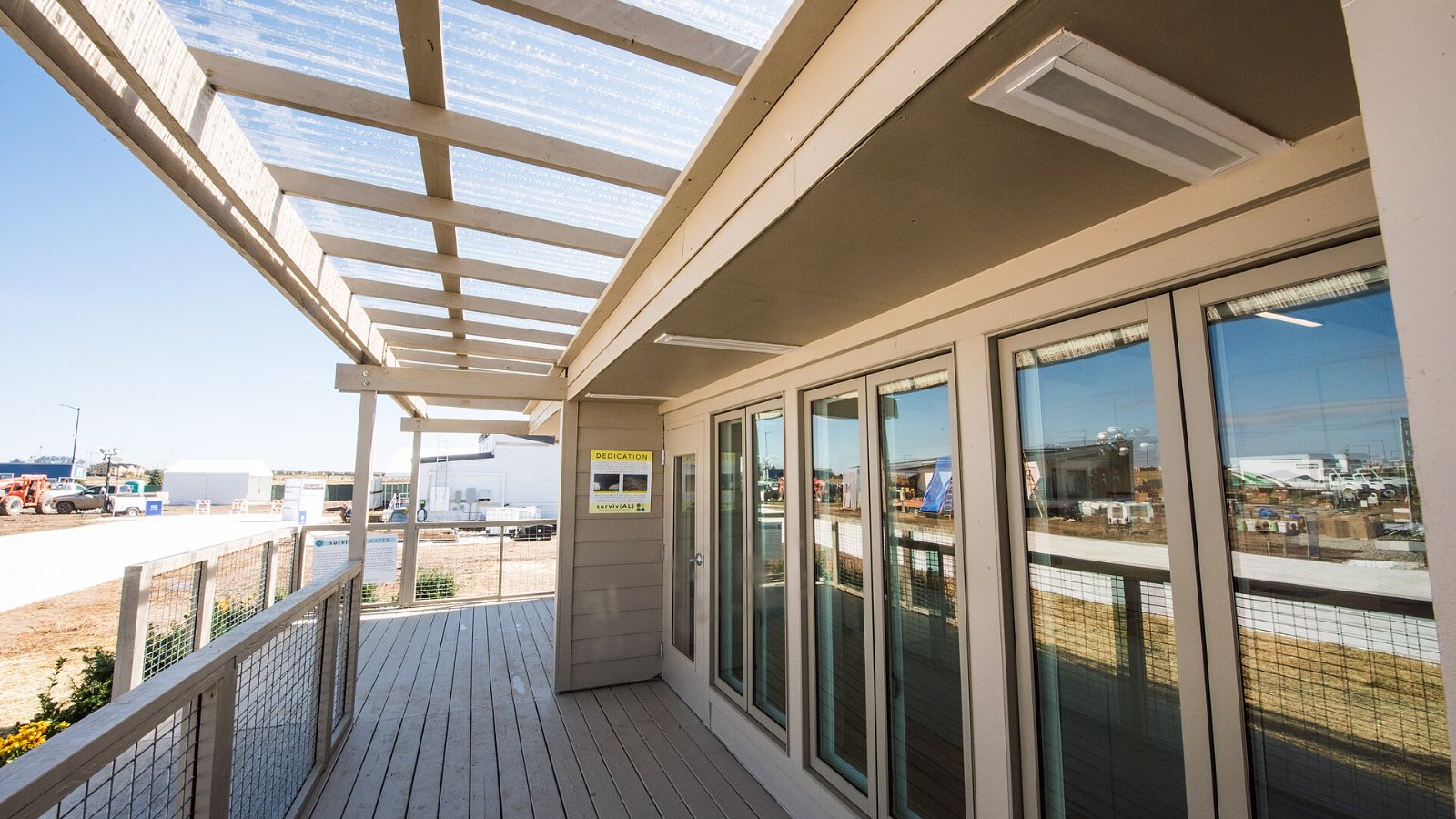
Cover photo: “SD2017 Gallery of Houses (37482564721)” by U.S. Department of Energy Solar Decathlon, public domain, via Wikimedia Commons.
Questions or a correction?
If something in this guide is unclear, out of date or does not match what your city told you, send me a message. Include the source if you have one.