By ADU Scope editorial team · Last verified: October 2026
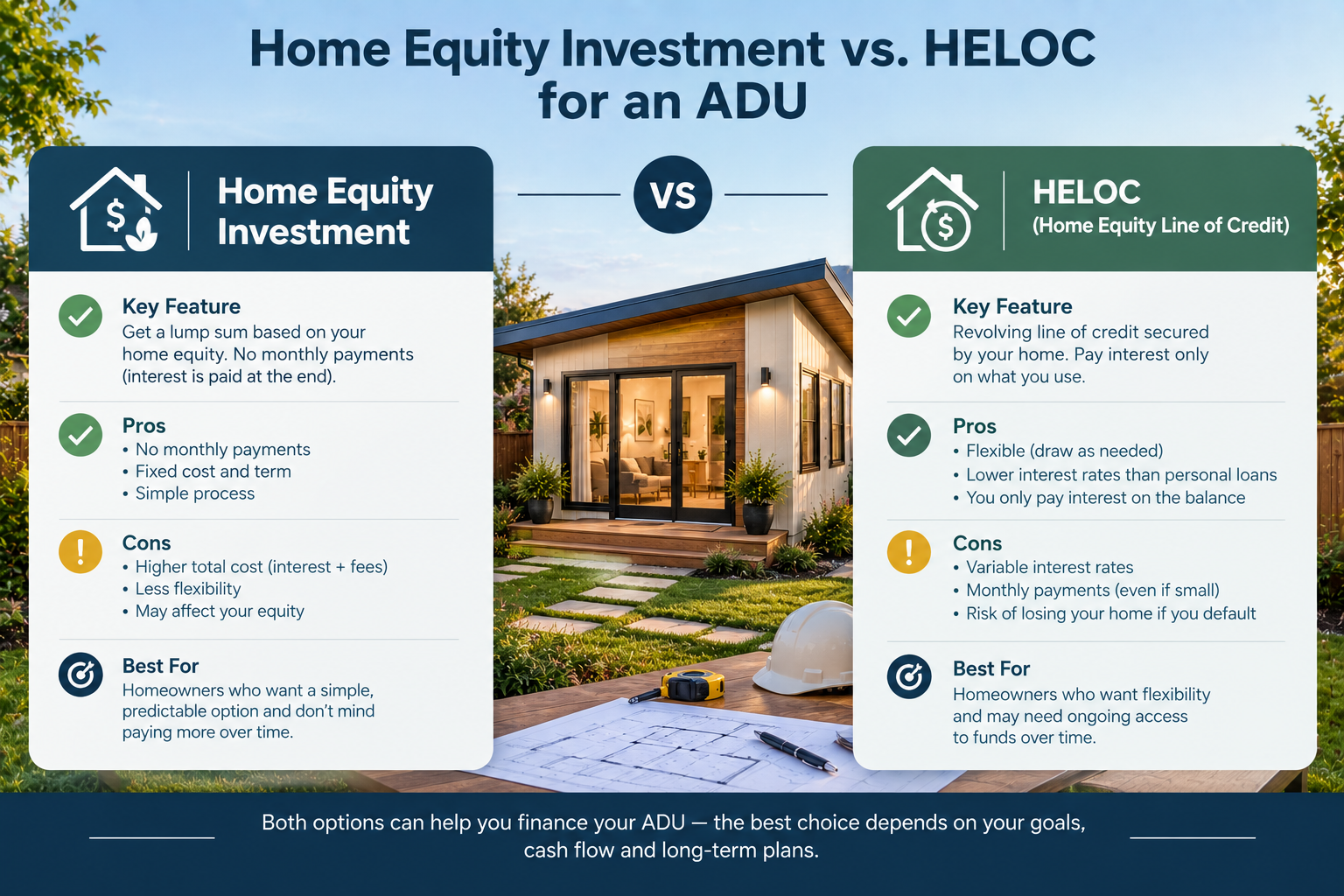
A home equity investment gives you cash today in exchange for a share of your home’s future value, with no monthly payment. For most ADU builders who can qualify for a HELOC, it is the more expensive route. In the hypothetical example below, an $80,000 deal costs far more than a comparable HELOC. In fact, that holds even if your home never gains a dollar. This is general information, not financial advice.
The Consumer Financial Protection Bureau (CFPB) calls these products home equity contracts. They suit homeowners who cannot qualify for debt or cannot carry a payment during construction. Therefore, everyone else should price a HELOC or a fixed-rate loan first.
How a home equity investment works
A company pays you a lump sum now. At the end of the contract, you repay it in full with a single payment. The CFPB’s January 2025 market overview describes the typical structure.
- Upfront cash: typically about 10% of your home’s value.
- Term: usually 10 to 30 years, with settlement at the end, on a sale or after a default event.
- Fees: about 3% to 5% of the initial payment.
- Multiples: commonly 2x, so a company that pays 10% of your home’s value claims about 20% at settlement.
- Growth: the CFPB found the investor’s claim grows roughly 19.5% to 22% a year early on, under most scenarios.
The CFPB estimates the market at $2 billion to $3 billion. It names four large companies: Unison, Point, Hometap and Unlock. We mention them only because the CFPB does, and we do not recommend any provider.
The report is a market overview, not a rule. Also, regulation is still evolving. States are active in this area, so check your own state’s law before you sign anything.
Home equity investment vs. HELOC: a hypothetical $80,000 example
All figures below are hypothetical. They use the CFPB’s common 2x structure, but real contracts differ in formulas, caps and floors. Cost here means what you repay minus the cash you actually receive.
Inputs and results for the home equity investment
Start with the contract terms we assumed.
- Home value today: $800,000.
- Payment requested: $80,000 (10% of value).
- Fee: 4% of $80,000, or $3,200, deducted at closing, so you receive $76,800.
- Investor claim at settlement: 20% of the home’s value (a 2x multiple).
- Term: 10 years, settled in one payment.
- Home appreciation: 0%, 3% or 5% per year.
| Appreciation per year | Home value in year 10 | Repayment (20%) | Cash you received | Cost (repayment minus cash) |
|---|---|---|---|---|
| 0% | $800,000 | $160,000 | $76,800 | $83,200 |
| 3% | $1,075,133 | $215,027 | $76,800 | $138,227 |
| 5% | $1,303,116 | $260,623 | $76,800 | $183,823 |
Notice that you owe $160,000 even if the house gains nothing. In other words, that is what a 2x multiple means. Moreover, a rising market makes the bill larger. The ADU you build may also raise the value that the company’s share applies to.
Inputs and results for the HELOC
Next, the comparison loan. We assume $80,000 drawn at a hypothetical 7.5%. Per the Federal Reserve’s H.15 release, the bank prime rate was 7.00% for the week ending Oct 2, 2026. We assume a 0.5-point margin on top. HELOC rates are usually variable, and we ignore closing costs.
| Option | Monthly payment | Cost over 10 years | Notes |
|---|---|---|---|
| HELOC, interest-only | $500.00 | $60,000 interest | You still owe the $80,000 principal |
| HELOC, repaid over 10 years | $949.61 | $33,954 interest | Balance reaches zero |
| HEI at 0% appreciation | $0 | $83,200 | Settles at $160,000 |
| HEI at 3% appreciation | $0 | $138,227 | Settles at $215,027 |
| HEI at 5% appreciation | $0 | $183,823 | Settles at $260,623 |
What the comparison shows
The pattern is clear. The HEI costs more than the HELOC in every scenario we modeled. A lower monthly payment is the main thing you buy. If you truly cannot carry $500 a month, that flexibility has a price. So know it before you sign.
It helps to translate the cost into a yearly rate. Growing $76,800 into $160,000, $215,027 or $260,623 over ten years equals about 7.6%, 10.8% or 13.0% per year. Those averages sit below the CFPB’s early-year range of 19.5% to 22%. The gap likely reflects the multiple applying from day one, so the yearly growth rate falls as the years pass.
Rates move, so rerun the math with a real quote. As of Oct 1, 2026, Freddie Mac’s survey showed a 30-year fixed mortgage at 7.28%, per its weekly release. Our guide to cash-out refinance vs. HELOC for an ADU shows how that rate affects a refinance.
When a home equity investment can make sense for an ADU
- A weak credit score or high debt-to-income ratio blocks you from a HELOC or refinance.
- You cannot carry a monthly payment during construction, before the ADU produces rent.
- You plan to sell or settle within a few years. You have also modeled the payoff at one, five and ten years.
Even then, however, price alternatives first. A smaller fixed-rate loan, a construction loan or a renovation loan may cost less. Start with our overview of how to finance an ADU and the guide to ADU construction loans.
Cheaper ways to avoid a payment during construction
If the monthly payment is your real obstacle, consider shrinking the project before you sell a share of your home. A smaller footprint or a garage conversion can cut the amount you need to raise. Our guide to the cheapest way to build an ADU compares those options.
An interest-only HELOC draw also keeps payments low while you build, as the $500 row above shows. The principal still comes due, so plan how you will repay it. Rent from the finished unit may help, although you should not count on it before a tenant signs a lease. See how ADU rental income affects loan qualification for the limits.
Risks the CFPB highlights
- Forced sale or foreclosure. Borrowers must repay in a lump sum. If you lack the credit or assets to refinance, you may have to sell, and default can lead to foreclosure.
- Hard-to-predict cost. You owe a share of value, so a strong market raises your bill. The CFPB also notes that complex terms hide the true cost.
- Fees reduce your cash. A 3% to 5% fee on $80,000 is $2,400 to $4,000 gone before you pay a contractor.
- Refinancing friction. Consumer complaints cite surprise at repayment amounts and difficulty refinancing a primary mortgage.
How a HELOC works for an ADU
A HELOC is a revolving credit line secured by your home. You borrow during a draw period, then repay. The rate is usually variable, and the lender can freeze or reduce the line. Because the home is collateral, missed payments also put it at risk.
The key difference is predictability. A HELOC has a known interest rate formula, whereas an HEI ties your cost to the market. Read our HELOC for an ADU guide for payment examples. Then check your borrowing room in how much equity you need to build an ADU.
Questions to ask before you sign a home equity investment
- Which percentage of value or appreciation do I owe, and on which base value?
- How much could I owe at most, including in a zero-growth scenario?
- What are all upfront and ongoing fees?
- What triggers early settlement, such as a sale, a refinance or a missed obligation?
- Does the company’s share include value that my ADU adds?
- What would I owe after one, five and ten years? Finally, ask for a written schedule.
FAQ on home equity investment and HELOC options
Is a home equity investment a loan?
Structurally it is a contract rather than a loan with interest. However, the CFPB notes the debt-like consequences, so read the contract instead of the marketing.
Can I settle a home equity investment early?
Many contracts allow it, but the amount depends on the contract formula and your home’s value at that time. Ask for worked payoff figures.
Is a HELOC always cheaper?
Not always, because HELOC rates can rise. In our hypothetical case, however, the HELOC cost less in every scenario. Overall, compare total cost, not only monthly payments.